São Sebastião decreta estado de emergência por causa de epidemia de dengue
Portal Aqui Vale
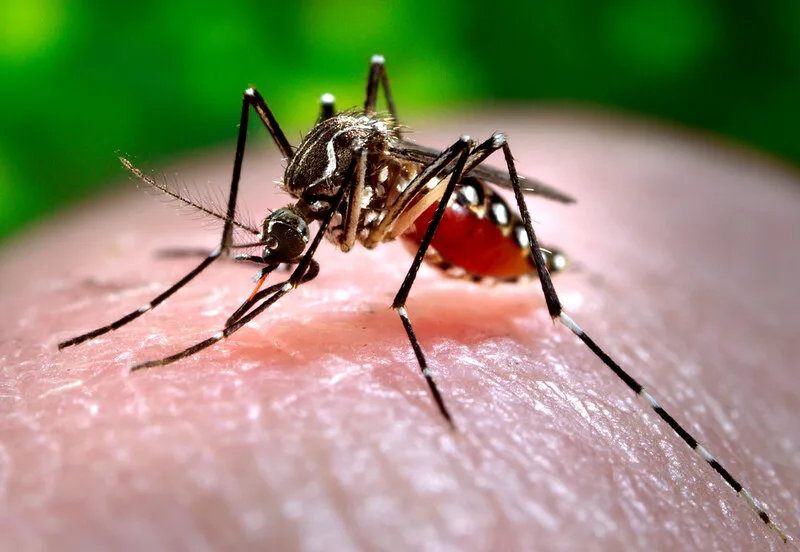
2006 Prof. Frank Hadley Collins, Dir., Cntr. for Global Health and Infectious Diseases, Univ. of Notre Dame This 2006 photograph depicted a female Aedes aegypti mosquito while she was in the process of acquiring a blood meal from her human host, who in this instance, was actually the biomedical photographer, James Gathany, here at the Centers for Disease Control. Youll note the feeding apparatus consisting of a sharp, orange-colored fascicle, which while not feeding, is covered in a soft, pliant sheath called the "labellum, which retracts as the sharp stylets contained within pierce the host's skin surface, as the insect obtains its blood meal. The orange color of the fascicle is due to the red color of the blood as it migrates up the thin, sharp translucent tube. The fascicle is composed of a pair of needle-sharp "stylets". The larger of the two stylets, known as the "labrum", when viewed in cross-section takes on the shape of an inverted "V", and acts as a gutter, which directs the ingested host blood towards the insect's mouth. As the primary vector responsible for the transmission of the Flavivirus Dengue (DF), and Dengue hemorrhagic fever (DHF), the day-biting Aedes aegypti mosquito prefers to feed on its human hosts. Ae. aegypti also plays a major role as a vector for another Flavivirus, "Yellow fever". Frequently found in its tropical environs, the white banded markings on the tarsal segments of its jointed legs, though distinguishing it as Ae. aegypti, are similar to some other mosquito species. Also note the lyre-shaped, silvery-white markings on its thoracic region as well, which is also a determining morphologic identifying characteristic.This females abdomen had become distended due to the blood meal she was ingesting, imparting the red coloration to her translucent abdominal exoskeleton.
A Prefeitura de São Sebastião decretou situação de emergência em saúde pública por conta da epidemia de dengue. O decreto, assinado pelo prefeito Reinaldinho Moreira, no dia 31 de março, entrou em vigor nesta semana. Em 2025, a cidade já confirmou mais de 500 casos da doença. Uma morte é investigada.
Entre as permissões estabelecidas no decreto estão a adoção de medidas necessárias à contenção de arboviroses, como aquisição de insumos e materiais, doação e cessão de equipamentos e bens, contratação de serviços necessários ao atendimento emergencial, prorrogação de convênios, entre outros.
São Sebastião é o município do Litoral Norte com o maior número de casos confirmados. Em sequência vem Caraguatatuba, com 308 casos, Ubatuba, com 223, e Ilhabela, com 159.